
Where Did the Seals Go?
Advanced Research Question 1: How do air and water temperatures affect the seal
counts in Fishers Island Sound over the course of a year?
Harbor seals migrate seasonally to Long Island Sound from the Gulf of Maine. At Project Oceanology, we typically see them in Fishers Island Sound from October to the end of April. The graphic below shows the migration ranges.
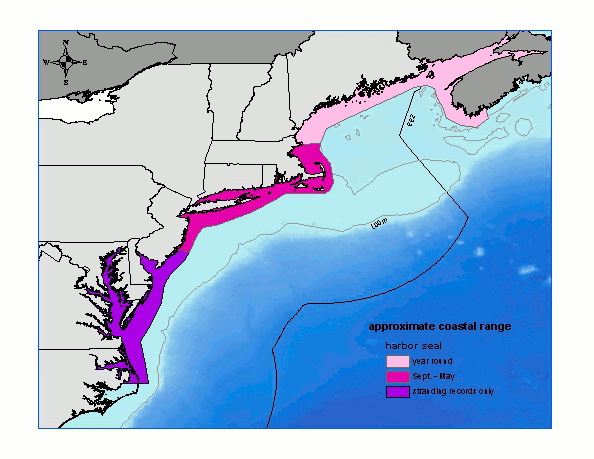
Source: NOAA NEFSC
Locate Long Island Sound on this map. What months do we see Harbor seals here? Think about air and water conditions for those months.
Seals have many physical and behavioral adaptations for thermoregulation, or maintaining their internal temperature. A harbor seal’s core temperature is about 37.8℃ (100℉), but there is typically a heat gradient throughout the blubber from the body core to the skin.
The image below shows thermal images of the skin surface temperature of a seal pup that has been basking in the warm sun (left), and the same seal pup after a 20 minute swim in cold water. The core body temperature of the seal pup is the same in both photos, but as you can see, the skin temperature can vary widely! Think about what this means for seal thermoregulation.

Image: Tang et al. 2013, 44th Conference of the International Association of Aquatic Animal Medicine
Harbor seals have a metabolic rate somewhat higher than land mammals of the same size. This helps them generate body heat for warmth. A thick layer of blubber insulates the harbor seal, reducing heat loss. The blubber of an Atlantic harbor seal during winter may account for 27% to 30% of its total body mass. Because seals are so well insulated, they can even overheat if their environment gets too warm!
Blubber also streamlines the body and functions as an energy reserve from which the harbor seal can draw energy during periods of fasting. A harbor seal’s hair provides only a small amount of insulation. In cold water, blood is shunted inward as blood vessels in the skin constrict, reducing heat loss to the environment. When hauled out on land, blood vessels in the skin may dilate, allowing heat to be exchanged with the environment.
Project Oceanology students are more likely to see seals when they are hauled out on the rocks. Seals haul out on the rocks to rest, but they do it more frequently and for longer when they also get a thermal benefit. During the time of year the seals are in Fishers Island Sound, both the air and water temperatures vary a lot. Water temperatures range from less than 5˚C (~40˚F), to more than 15˚C (~60˚F), and air temperatures vary even more: from below freezing (<0˚C/<32˚F), to more than 20˚C (68˚F)!
Part A: Prediction and Reasoning
Write answers to the following prompts on your sheet of paper.
1. Make a prediction: Under what combination of air and water temperatures would you expect seals to benefit most from hauling out?
2. Explain your reasoning: WHY do you think that combination of air and water temperatures would benefit the seals?
3. Make a second prediction: What month of the year would you be most likely to see the favorable air and water temperature combination you mentioned in #1?
4. Explain your reasoning: WHY would you expect to see that air and water temperature combination in that month?
Part B: Analyze the Data
Look at the dataset below. On your piece of paper, illustrate the data by making a graph. Your graph should have clear labels on both the x-axis and the y-axis. The type of graph (scatterplot, column graph, etc) is up to you.

Part C: Interpret the Results and Make Arguments from Evidence
Write answers to the following prompts on your sheet of paper.
1. Make a claim that answers the research question (one sentence).
2. What evidence was used to write your claim? Reference specific parts of your graph.
3. Explain your reasoning. Make sure to connect your answer to what you have learned about air and water temperatures and seal biology.
4. Was your prediction supported by the results? Use evidence to explain why or why not.
5. Think back to our scenario at the beginning. Based on today’s date, is your data point (20 seals) or your friend’s data point (200+) the outlier?
6. How would you follow up? Describe a new question that should be investigated to build on these results, and what future data should be collected to answer your question.
Congratulations! Your final analysis should include the following components:
-
Your answers to the two video questions
-
A statement of the research question that you chose/were assigned
-
Your prediction and your reasoning
-
Your labelled graph
-
Your answers to the results questions
Share your results with your teacher, and/or by emailing it to Project O: projecto@oceanology.org, attn: Dr. Molly