top of page

Unidentified Animal 7
Based on the videos below see if you can identify the specimen that was retrieved in the otter trawl.
For each question there will be 1 - 3 choices for you to decide between. To move to the next option, click "Choice A", "Choice B", or "Choice C". If you answer a question incorrectly, you will be directed to a drawing of an organism. Click the blue button below the drawing to return to the question to try again.
Colus spp., whelks
Occurs near shore north of Cape Cod but only offshore and in deep water to the south. Colus stimpsoni, Stimpsons whelk, the largest and most common species, has a white shell with a thin brown outer shell covering; grows up to 13 cm (5") long. The other two local Colus species are under 62 mm (2 1/2") long.
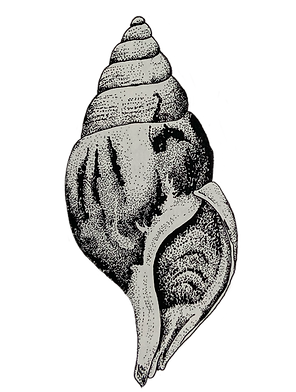
opening about 1/2 shell length
Colus spp., whelks
Busycotypus canaliculatus, channeled whelk
Beige or yellowish gray; often covered with a hairy outer shell layer; up to 20 cm (8") long; very common in shallow water on sand; has distinctive egg case.

opening about 3/4 shell length
groove or "channel"
channeled whelk
Busycon carica, knobbed whelk
Gray, sometimes with purplish streaks; largest snail in this region, up to 23 cm (9") long; lives in shallow water on sand, not as common as channeled whelk; produces distinctive egg case.
knobs

opening about 3/4 shell length
CORRECT
You have successfully identified the Knobbed Whelk
knobbed whelk
bottom of page