top of page

Unidentified Animal 4
Based on the videos below see if you can identify the specimen that was retrieved in the otter trawl.
For each question there will be 1 - 3 choices for you to decide between. To move to the next option, click "Choice A", "Choice B", or "Choice C". If you answer a question incorrectly, you will be directed to a drawing of an organism. Click the blue button below the drawing to return to the question to try again.
Question 3
Question 3
Choice A: Large head (from tip of snout to back edge of gill cover) is nearly 1/3 total body length (from tip of snout to rear end of caudal peduncle); pelvic fins with 7 rays; rear margins of scales are straight and edged with comblike teeth.
Choice B: Head is 1/4 or less total body length; pelvic fins with 8 or 9 rays; rear margins of scales are rounded and smooth.
Question 5
Question 5
Choice A: Tip of lower jaw projects noticeably beyond the upper jaw when mouth is closed; with 18-23 gill rakers on lower limb of first gill arch.
Choice B: Tip of lower jaw does not project much beyond the upper jaw when mouth is closed; more than 25 gill rakers on lower limb of first gill arch.
Question 6
Question 6
Choice A: Upper edge of lower jaw rises at a slight angle and is nearly straight; tongue is visible in profile when mouth is open; cheek bone is higher than long.
Choice B: Upper edge of lower jaw rises in a steep concave curve; tongue not visible in profile when mouth is open; cheek bone length nearly equals height.
Question 7
Question 7
Choice A: Snout (distance from front edge of eye to tip of upper jaw) is shorter than diameter of eye; lining of belly cavity is usually pale grayish or pinkish white; with 38-44 gill rakers on lower limb of first gill arch.
Choice B: Snout length equals eye diameter; lining of bely cavity is usually blackish; with 41-52 gill rakers on lower limb of first gill arch in adult.
gizzard shad
Dorosoma cepedianum, gizzard shad
Silvery on sides, white underneath, young have round dark spot behind operculum; up to 41 cm (16") long; strays into estuaries from freshwater.
last dorsal fin ray is long and filamentous
round snout overhangs mouth

Brevoortia tyrannus, Atlantic menhaden
Silvery sides, darker back; up to about 40 com (16") long; very common in large schools often near surface.
head large, about 1/3 of total body length
pelvic fin with 7 rays
anal fin is behind dorsal fin

atlantic menhaden
atlantic herring
Clupea harengus, Atlantic herring
Green or blue on top, silvery on sides; up to 46 cm (18") long.
dorsal fin begins midway between tip of snout and rear end of caudal peduncle
pelvic fin with 8-9 rays
anal fin is behind dorsal fin

hickory shad
Alosa mediocris, hickory shad
Grayish-green above, silvery below; usually 25-45 cm (10-18") long.
dorsal fin begins nearer tip of snouth than rear end of caudal peduncle
lower jaw project well beyond upper jaw when mouth is closed
edge of belly is saw toothed

pelvic fin with 8-9 rays
anal fin is behind dorsal fin
american sha
Alosa sapidissima, American Shad
Green or blue above, silvery on sides; less than 75 cm (30") long.
lower jaw projects only slightly beyond upper jaw when mouth is closed
pelvic fin with 8-9 ra
Alosa sapidissima, American shad
Green or blue above; silvery on sides; less than 75 cm (30") long.
dorsal fin begins nearer tip of snout than rear end of caudal peduncle
lower jaw projects only slightly beyond upper jaw when mouth is closed
edge of belly is saw toothed
pelvic fin with 8-9 rays
anal fin is behind dorsal fin

alewife
Alosa pseudoharengus, alewife
Grayish-green on back, silvery sides; up to 40 cm (16") long.
dorsal fin begins nearer tip of snout than rear end of caudal peducle
anal fin is behind dorsal fin

pelvic fin with 8-9 ra
lower jaw projects only slightly beyond upper jaw when mouth is closed
snout is shorter than eye diameter
blueback herring
Alosa aestivalis, blueback herring
Bluish above, silvery on sides; usually less than 30 cm (12") long.
dorsal fin begins nearer tip of snout than rear end of caudal peducle
snout is shorter than eye diameter
lower jaw projects only slightly beyond upper jaw when mouth is closed
anal fin is behind dorsal fin

pelvic fin with 8-9 ra
butterfish
Peprilus triacanthus, butterfish
Grayish above, silvery on sides; usually less than 25 cm (10") long.
jaws do not extend beyond eyes

no pelvic fin
anal fin is under dorsal fin
CORRECT
You have successfully identified the Butterfish
bay anchovy
Anchoa mitchilli, bay anchovy
Silvery with indistinct silvery horizontal stripe; up to about 9 cm (3 1/2") long.
indistinct silver stripe

24 - 27 anal fin rays
jaws extend well behind eyes
anal fin begins under front of dorsal fin
striped anchovy
Anchoa hepsetus, striped anchovy
Silvery with bright, silvery horizontal strip; up to about 15 cm (6") long.
distinct silver stripe
20 - 21 anal fin rays
jaws extend well behind eyes
anal fin begins under rear of dorsal fin

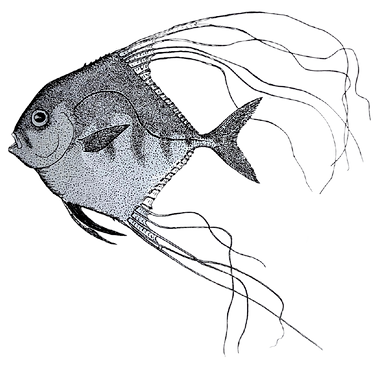
Alectis ciliaris, African pompano
Very thin with silver sides; rarely over 10 cm (4") long; occasionally found near shore in late summer and early fall.
tiny spines
convex forehead
threadlike extensions of dorsal and anal fins
.png)
pompano
bottom of page